So long, Spain

Woah. Dudes. I go home in a little over a week. I am finishing up school, saying goodbye to my kiddos, packing my bags, and saying Adios to this country that I have fallen in love with. Its been a wild ride, but here are some last reflections I wanted to share about my time here (for like the 3 people who read my blog).


Food:

I talked about this a lot, but I really liked the food, mainly because it was different. It forced me to get out of my comfort zone and not be a picky eater. I didn’t like everything I had, but I tried everything that was placed in front of me and I found some things I really liked. Some of my favorites were choco (fried squid), paella (classic), jamon (ham), gazpacho (cold tomato soup) and tortilla. Some things I didn’t like, gambas (shrimp), pescado fresco (fish still attached to their bones), and certain soups. I do miss the variety of American food and the diversity of it. It is super difficult to find things like good Chinese/Mexican/Italian food while you are here. Some other assorted favorites:

–          Tosta rica bisquits. Like a nilla wafer but better

–          Nocilla. It is the Spanish Nutella but better

–          The ice cream here is super good. Its very similar to gelato. My favorite flavor was arroz con leche (rice pudding)

–          Fruit here was very good. The area is known for their oranges, mandarins and strawberries.

 

IMG_8214 I just wanted to share this salad. That’s all.


Favorite trip:

My favorite trip was Granada. Mainly because I really like cold weather, but it was very different from other cities that I visited. It was a perfect mix of history and technology. I wish I could’ve spent more time there. It was a bit more of an expensive trip than initially planned, and I wish that I had had more time to ski to get my moneys worth, but overall it was very fun. I loved visiting La Alhambra, which was probably my favorite historical landmark that I have seen in Spain. The only downside of this trip was that I was quite sick with bronchitis, so skiing and walking the many flights of stairs did not leave me feeling very well. I ended up coughing so hard that I pulled a muscle in my chest badly and had to go to the hospital. Oh well. It was a good birthday weekend. The whole extended family went so it was great to spend time with them.

IMG_7674 Posing in front of one of the many beautiful arches in a garden in Alhambra.


Pros and cons about the host fam

Pros:

–          I had constant support during my 10 months here. If I had a problem, I had someone to go to. If I needed help with something like when I had to get all my documents and bank stuff, I had someone to help and translate for me. They helped me with so many things, such as getting my DNI (id) card, activating my bank card and picking me up from the airport and such.

–          I got to be included in holidays. I got to experience traditional holidays such as New Years with the 12 grapes, and opening gifts from the 3 wise men on Epiphany. I got to see traditional Easter processions and witness and participate in a pilgrimage. Doing these things really helped me better understand the culture and having a family to experience them with was awesome.
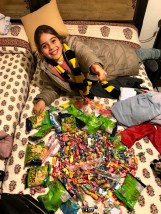
IMG_6778.jpg Elena and her candy haul from the Three wise Men parade (I made her share)

–          I wasn’t alone. I had to be social. Living with a family plus a dog forced me to interact.

–          My Spanish improved way more than if I had lived independently.  I was able to practice (even though my family spoke very good English). They were able to correct me when needed. I also got more comfortable hearing Spanish and with that I can follow conversations well.

–          I got to have an extended family. My host family wasn’t just the people I lived with. Living with them, I also developed relationships with the aunts, uncles, grandparents, cousins… I now have a huge “Spanish” family, who I really care for. I loved spending time with the grandparents, going shopping with the Aunts, watching the cousins (sometimes).

–          I got to experience having younger siblings. This was a mix of a pro and con. Being a twin, I have never lived with children younger than me, and I never had to deal with younger siblings. My host sisters, Cristina (11) and Elena (8) treated me like a sister. Which means that while we had fun, we would bicker sometimes. Or they wouldn’t want to listen to me when I was watching them. But we became very close. And I am going to miss them a lot.

 

IMG_8115 Cristina and Elena liked to steal my phone sometimes…


–          Financially, this was a good choice. Being with a host family, I got to live rent free for almost a year. I didn’t have to pay for any bill’s, and I didn’t have to buy my own food (unless I wanted something special). While my salary was a lot less than someone in my program who chose to live independently, it was nice to just be able to focus on my job and my experience here, rather than worrying about bills, apartment hunting and things like that.

–          I got to eat and try authentic Spanish food. If I had been living by myself and I can guarantee you that I would have been eating the same few things every night for dinner. But being with a family, I was able to try tons of new foods and new flavors. I didn’t like everything I tried, but I really liked being able to get a taste of true Spanish food.

–          My host family had a dog. His name is Mickey and he is the craziest creature I have ever met. Not a lot to say here, but I was happy to be placed in a family with a dog.

IMG_8209 This is Mickey. He looks sweet, but in reality, he is psychotic and will eat anything (I’m talking rocks, plastic, meat, trash, dog beds, stuffed animals, shoes, poisonous caterpillars.)


Cons:

–          I couldn’t always do what I wanted to. I am not saying that when I am in my house in America, I run wild and there are no rules, but when living with a host family you have to follow their schedule and their rules, even if it seems strange to you. For example, one thing I struggled with was adjusting to the mealtimes here. I personally prefer to go to bed early, especially if I have work the next day. When living with a family, you are expected to adhere to their mealtimes. So, every night we would eat dinner any where from 9:30-10:30, which, even after being here for almost 10 months, I really did not like. At all. I still don’t. My host parents were nice though and would let me eat dinner by myself earlier if I was tired. I really hope they didn’t get offended by that. But staying up that late just to eat dinner is difficult for me (and by that point I’m not even hungry). I also had to follow Spanish customs and rules. This was especially so because I lived with children, I had to be an example. One random thing that I kept having to get reminded of was the strange rule of having to wear shoes all the time here, even in the house. I really hate wearing shoes in general, and back home I never where shoes or even slippers in the house. But here, you must, it’s a weird cultural thing. That was a challenge at first, remembering to follow that. In general, though, my host family was relaxed about the rules and stuff. If I wanted to go do my own thing, like meeting up with a friend in Huelva for lunch or going to Seville with some friends for the weekend, they never had a problem with it, if I told them ahead of time.

–          Host siblings. Disclaimer: I truly love my host sisters, Cristina and Elena. They are great girls and they are like my actual sisters now. However, they are kids. And kids… are annoying at points. And being someone who has never lived with young children before, this was a learning curve. I thought I was equipped to handle deal living with kids since I am a teacher and have worked with children for years, but alas, I was not. They get on your nerves. They touch your things. Go into your room. Don’t listen. Challenge you just because they can. So, we would bicker sometimes. But it was always shortly resolved and over all we had a good relationship. (am I still salty that they broke one of my lipsticks writing a note with it? A little. But that’s another story).

–          You never fully feel comfortable. Don’t get me wrong, my host fam was super accommodating and literally went above and beyond to make me feel welcome. I would say I felt 98% comfortable in this new environment, but as well all know, there is no place like home. I never really got to the point where I was comfortable enough to say, walk around in my pajamas or snack on what I wanted to. Overall, I was able to feel at home, but like I said, its not your own place, you are in someone else’s home.

–          Sometimes being with a family made me more homesick. This was especially true during holidays. Seeing another family interact and spend time with each other sometimes made me miss my own family even more. Hugging my host Abuela made me want to be hugged by my own grandma. Going shopping with my host mom and her sister made me want to spend time shopping or having a girl’s day with my mom and aunt. I was lucky I had a family to spend holidays with, but subconsciously I found myself comparing it with my family back home. Like when we decorated the tree for Christmas, I kept thinking, “we would do that differently back home”. Again, I was lucky to have a host family, but being apart of a host family made me unexpectedly home sick.


Thoughts about the school:

Overall, I really liked the school I taught at. I got along well with my students, my advisor and the other teachers. They were all very kind and welcoming and never made me feel like I was less important just because I was a student teacher. I enjoyed getting to know my students and didn’t experience any major problems with any of them. I had classes that I preferred more than others, but overall the students were pretty respectful (the teenagers behaved as expected). Once I learned more about their interests and they got to know me, they became more comfortable speaking in class and participating in activities. However, one issue I had in the school was the overall lack of communication between me, other teachers, administration, etc. There were many occasions where I wasn’t informed or informed late about something important, like a meeting or schedule change. Often, I would look out my window of my classroom during the break periods to see the whole school and all the teachers gathered outside for some type of assembly, and I wasn’t made aware of it. I was often the last to find out about holidays off or when exams were. This was very frustrating because I wouldn’t have a lot of time to prepare for important things or to rearrange my schedule. It really irked me sometimes.

The weather:

When I first arrived, I hated the weather here. In RI we do get hot weather, but it is very humid, and we get a lot of rain. And usually by September, it starts to cool down, especially at night. In the South of Spain, that is so not the case. When I first arrived, it wasn’t until October that the temperature dipped below 85 degrees. It didn’t rain until late October and was super dry and sunny. I personally don’t like summer weather, so it took a while for me to get used to. The weather started to get more pleasant in November/ December. To the people here it was cold. During the day in the winter it is usually between 50-60 degrees and at night it gets down the mid-30s. So, if I went on a run in the morning I would usually be find in leggings and a long-sleeved tee-shirt and if I ran in the afternoon, I would usually wear shorts. I got a lot of weird looks from the neighbors when they would see me run in shorts in January. It never snows in Huelva, but we would get frost sometimes. And in the winter, it would rain at least once a week. It started really getting warm again around early April and now to me, it feels like the middle of the summer. I have been told it can get up to around 110 degrees in July/ August, but I am very glad I won’t be here for that.


Friends/ Social life:

Unlike young people who study abroad/Erasmus students, I wasn’t often around people my age. I lived outside of the city, so being able to get to the city to do what a want was sometimes a hassle. There also wasn’t a lot of students in my program in the area, unlike some of the larger cities. Huelva does have a University and there are other English teachers/ international students, but again, they were all living in the city and I was not. I was connected to the TEFL teachers group chat and on the Facebook group, but often if they were planning something, it was at a time I couldn’t make it. So, while I enjoyed my nice quiet neighborhood, as a young person, it wasn’t always very convenient. I did make some friends while I was here though. I became pretty good friends with the language assistant at my school’s brother school, Ben. I also made friends with the other students in my Spanish class and a few other English teachers. It was nice to be able to shoot someone a text every now and then to go grab a tapa or go to the beach or something. Also, I was able to go on a few day trips with some friends, to places like Seville or to the local beaches. Was I as social as I hoped? Probably not. But then again, I am not an extrovert, and I would rather have a few good friends anyway than a large group.
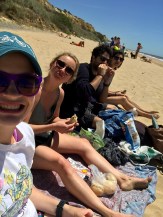
 

IMG_8278 Me and my friends from Spanish class at a beach in Mazagon, Huelva.

Firsts:

This experience really pushed me in ways I didn’t expect. I experienced a lot of firsts while here. Minor ones such as taking a taxi and a foreign subway by myself. Ordering a coffee in a different language. Drinking coffee regularly. Traveling internationally alone. Booking flights alone. Getting stuck in a foreign country (Looking at you, Dublin, Ireland) alone on Christmas. Navigating through a city without a phone/map.  Kissing strangers on the cheek. Staying in a Youth Hostel (don’t watch the movie, Hostel, by the way). Taking Spanish classes. Teaching for the first time. Earning a degree while teaching for the first time. Learning about the Cambridge exams and being expected to be an expert on them. Experiencing bilingual education. Working with 1-2-year old’s. Being 3000 (?) miles away from my family.  While some of these things sound simple (like, who would stress about taking a taxi?) these were all things that I have never done before (that makes me sound sheltered). Every new experience made me take a step out of my comfort zone. And once I did them for the first time, such as navigating through the city by myself, everything became easier. I went from not being able to speak a bit of Spanish, to being able to hold a conversation with a stranger, ask for directions, order food by myself.

Another way that I have grown this year was I have stopped (or tried to stop) comparing myself to others. When I first started, I was subconsciously comparing myself to other teachers, former language assistants like me, and my classmates in the program and in my Spanish class. My need for perfection made me more stressed out than I needed to be. I had to remind myself that no one was expecting me to be know exactly what I was doing. I am a first-time teacher, barely out of college. It was okay to ask for help. It was okay to not know the answers to everything. My program is a teacher’s training program. Meddeas is not meant for experienced and expert teachers. I was learning while working. As the year progressed, it got easier.

Things I will miss:

–          How inexpensive everything is here. Because I am in a smaller city, the cost of living is significantly cheaper than in the US. I can get a full breakfast at a café for less than 2 Euros and food in general at stores and in restaurants is cheaper. Although I didn’t have to get a flat, housing is very inexpensive here as well (compared to bigger cities or in the US).

–          The area I live in. This year I lived in a very nice gated community, attached to a golf club. It was nice to be able to go running or on a bike and not worry about cars. It was also a very safe neighborhood and I never felt uncomfortable or unsafe while outside. And there are a lot of cool wood’s paths for running, which I really enjoyed. Also, palm trees. Those were nice.

–          Being able to travel. Although I didn’t that often, traveling within Spain and the rest of Europe is very easy to do. I didn’t get to go to a lot of places, but if I had had the time, it would’ve been easy to do so. (I didn’t make it to Portugal though, and it is only 40 minutes away!)

IMG_6413 In front of the Palacio de Cristal in Madrid.

–          I really enjoyed being able to discover new places and develop opinions about where I live. Being here for a year, I was able to learn a new city, not as a tourist but as a resident. I had to find my favorite café, favorite grocery store, bus route, which cinema showed English films, which restaurant had the best tapas, etc. Almost every time I went into the city, I discovered something new.

–          While it did aggravate me sometimes, I will miss the slower way of life here. People really take their time to do things and spend time with each other. Mealtimes are a social time and people take it seriously. I have gotten used to the Spanish way of doing things (such as meal-times). Although I didn’t like eating dinner at 10 pm, I did like how basically snack time is a scheduled thing for everyone.

–          I will miss hearing Spanish. Although I didn’t progress as well as I had hoped with Spanish, it became easier, poco un poco (little by little). Slowly but surely, I found my self being able to understand the TV, the people on the bus and in the streets, my host family when they were talking around me. It has become comforting in a way to hear Spanish around me, and often, I no longer need to translate it in my head, I just understand it. Its just words now.

–          My students. I truly love my students that I had this year. Some of them aren’t my favorite, and some days I didn’t have a lot of patience, but it was a good feeling when I had students frantically raising their hands to be the first group to do conversation practice, or having a group of them say “HI MISS JORDAN” in the hallway, or when a one of them specifically requests to play a game they really enjoyed. I can honestly say I did not dread going to work in the morning, and I really enjoyed being there at the school and teaching. Some days it was difficult, but overall, I really liked it and I will miss it.

–          While I missed my family so much, and I can’t even put it into words, I really liked being able to call them and talk to them from abroad. I looked forward to our phone calls and it would always make me happy to Facetime them. While I can’t wait to see them in just a matter of days and be with them full time again, having to rely on Facetime, snap chat, and Facebook to talk made our conversations really special to me, and just reminded me about how lucky I am to have such a great support system 3000 miles away.


So, what now? Am I going to continue teaching? Is ESL my calling? Am I coming back to Spain next year?

No.

While I enjoyed my experience here, and I 100% am happy that I did this, I decided not to do the program for a second year (as was offered). There were a few reasons why I chose not to continue teaching, and mainly it is because I miss my family and home and for financial reasons. As some people know, TEFL jobs abroad do not pay very well and people primarily do them for the experience. (I also have a butt load of student loans to pay off).

I am still staying in the educational field though! I accepted a job working as a Behavior Therapist for an educational ABA therapy company (Applied Behavioral Analysis). So, I will be working with students on the Autism spectrum and with other communicational and behavioral differences. I really think that my experience in Spain will help with this, because I have gained knowledge on how to work with a communication barrier as well as preparing curriculum. Upon returning to the States, I also have a few other interviews lined up. I am super excited to take this experience (how many times have I used the word “experience”?) and utilize what I have learned, while also applying what I studied in college (gotta use that degree at some point!)

So, thank you. Thank you to all the people I have met here. Thank you to my students, my host family, my co-workers, my friends. Thank you for this beautiful country that I was so lucky to call home for the past year. But most of all, thank you to my family and friends (and anyone else who reads this) who have supported me during this crazy year. I am so grateful and lucky that I was able to do this.

Adios, Espana. Hasta luego. Gracias por todo. Voy a Volver.


Peace.


Some other observations (Its the final countdown)

Hello, friends.

So, back in October/November, I wrote a post about my personal observations/things I have noticed and learned here in Spain. Now, with just one month left in this awesome country, I thought I would write a continuation of that post, because as expected, I have learned and observed a lot more compared to when I first arrived here.  Am I more cultured and experienced than I was 7-8 months ago? Probably not.  Do I have more to talk about? Always.

So sit back, grab some tinto de Verano and enjoy.


  1. Family is very important here. Of course, family is important in America too, but here even more so. Maybe its just the fact that people tend to live closer to their relatives here, but it is very common to frequently get together for meals and other events here with your extended family. Most young children don’t go to day care either and they are usually watched every day by their grandparents or other family members. People also eat together more often that we do in America. My host family eats every meal together, every day. I’m sure there are families that do this in America, but here it is unusual to eat alone or to want to spend time alone. For my family back home, we all have very different schedules with work and school, so doing things such as eating meals together doesn’t happen as often as we would like. Overall, Spain has a very family-oriented culture (which is a good thing).
  2. There are a lot of different social rules. I mentioned in the earlier post that people are very physical, with touching and with proximity. When people speak to each other, they get quite close to you (like only a foot or so apart). Personally, I am someone who really values personal space so this made me uncomfortable at times, especially if it was someone who I was unfamiliar with. Also, in public, people are loud, even at restaurants and on public transportation. In America, its considered rude to be speak loudly in shared places, but here, it is how you are heard. I had difficulty with this and often people have asked me to speak up. There are also different social rules on what is appropriate to wear and what isn’t. People in Spain and in most European countries tend to be more well dressed compared to Americans, and it is often easy to tell who are the foreigners in the city. But there are also unspoken rules on what season is it appropriate to wear certain items. Even though I live in a very warm region (the usual high was around 60-65 degrees F in the winter) people would still wear winter clothing and coats. It is considered weird to wear short and “summer” clothes outside of summer. For example, I have only recently started to see people wearing shorts and shorter skirts in public and it is mid- May (and in the 90’s). I would get strange looks from neighbors when I would wear shorts on runs in February. To me, it was warm, but to them, I was committing a fashion faux pas. Oh well.
  3. There is not a lot of variety. Let me explain. If you go to a grocery store in America, there is always a ton of different flavors to choose from for things like cereal, ice cream, yogurt, chips, cookies, etc. Americans love their variety. We love having a bazillion options for flavors and are always coming up with new flavors for things (ever had chicken and waffles flavored chips? Its life changing).

Here in Spain, it is very different. If you go to the soda section, there are two types to pick from: Coke (diet and regular) and Fanta (orange and Lemon). If you go to the cereal section, there are maybe 4-5 different types. Go to the ice cream section, you can pick from a couple. And there aren’t any flavors or brands that are exclusive to one store. Pretty much every grocery store in Spain is the same. If you go into a restaurant, the menu will more or less be the same in the restaurant next door (unless it is a specialty restaurant). Go to an ice cream shop, the flavors are the same in the other shop that you went to last time. Even with things like pizza, it’s the same flavors at every shop.  Also, things like flavored coffee doesn’t exist here. Its either café con leche or café sin leche (with or without milk). People here like what they know, and what they have is good. If its not broke, why fix it?


(why are most of my observations food related?)


  1. Going along with food… Special diet things are hard to come by here. This might just be because I live with a host family and I don’t have too much control over what I can eat, but if you have a dietary restriction or choose to eat a certain way, it can be difficult. At stores, it is more common now to find gluten free things and some lactose free things, but it can only be really found at the larger grocery stores (what’s up, Super Carrefour?) And compared to America, there is not a lot of variety. Also, if you are vegetarian/ vegan, good luck. Personally, I don’t like eating a lot of meat. I try to make the majority of my diet plant based, especially when I was living on my own in College. Here, that is not an option. It is super hard to find good vegetarian/vegan options at restaurants. I have been to restaurants where there were no vegetarian options. Even the salads have meat or fish on them, or things are cooked with chicken broth or something similar. Prior to my arrival, I had considered becoming a vegetarian. I am glad I put off that, because it would’ve been almost too difficult to manage, especially because I don’t live alone and have to eat what my host family eats. Also, if you don’t like fish, don’t come to Southern Spain. Just saying.

Moving on from food…


  1. Race/religion and identity is different here. America is a country made up of many different races, cultures, religions and social identities. We are taught from a young age that racism is wrong, to be aware of those different from us and always be respectful of other cultures/religions/ races/ identities and use proper terminology. While unfortunately not everyone does this in the US, the majority of people are aware and know that it is the right thing to do. It is the normalized culture to be very sensitive to other’s differences and to try your best to be as politically correct as possible. From my observations, this is not often the case in Spain. In the region I live in, it is not very culturally diverse. There are a small handful of people of Asian descent, a small amount of people who immigrated from different parts of Africa, but other than that, it is mostly native Spaniards. In Huelva, there are very few people who speak English (outside of my school) and it is rare to hear any other language besides Spanish being spoken in the streets. I have been told off before by strangers when they hear me trying to speak in Spanish or when I have a friend/ family member translate for me. They say something along the lines of “You’re in Spain! Learn Spanish!” People here can sometimes be dismissive if you are not comfortable using Spanish. Also, I have noticed that they are not as culturally aware or sensitive as we are in America. I am sure they do not mean to do this or don’t intend to come off as insensitive or rude, but I have noticed them say and do some things that would not be socially okay in the US. An example of this is how they refer to what we would call “African Americans”, “Black” or how they call all Asians “Chinese”. Also, on the Three Kings day (El Dia de Los Reyes), often in parades when they have people dressed as the three wise men, they will have someone wear blackface to represent the King that was from Africa. As everyone knows, in the US, you CANNOT wear a black face. It is super racist. The people here don’t view it as racist though.

Also, because this country is predominantly Catholic, people here don’t really learn about or exposed to other religions or faiths. It might just be the school I work at, but for the most part, the students don’t learn about other religions or holidays. I remember in school we would at several times have a unit in class about world religions (the main ones, primarily). In the US, it is super common to see different houses of worship (synagogues, temples, churches, etc.) and to know people who go there. Here, I have never seen a Jewish synagogue, a Muslim mosque, or a Protestant church. Again, not a bad thing, but the concept of separation of church and state that is really enforced in the US is not such a priority or a necessity here.


  1. People take their time here. The US is known for being super-fast paced and everything is on the go. Not here. If you go to a restaurant, you will most likely be there for at least 2 or 3 hours. If you go get coffee with someone, you will be there for an hour. On a walk? 2 hours. Meeting up with a friend? All afternoon. Saying goodbye? That’ll put you back a good 45 minutes. People are also often late for things. If you tell someone to meet up at 5, they will be there for 5:30. Even at school, if the class starts at 9, the teacher gets to the room at 9:05-9:10. My students asked me in the beginning of the school year, “Miss Jordan, why are you always so early?” when I arrived to class at the time it was suppose to begin.
  2. People aren’t as polite here as they are in other countries. I am not saying that they are rude, but if someone bumps into you, they aren’t going to say anything. I have been told that in places like the US and England, we are over polite and say things like, “sorry” and “excuse me” a lot. My Spanish teacher told me to stop apologizing every time I made a mistake. It’s something I don’t even think of, its just an automatic response.
  3. As an outsider of the Spanish language, and being someone who is teaching a foreign language, I have noticed collectively there are some funny/interesting mistakes that are super common with Spanish ESL learners (with kids and adults). These are a few common mistakes that I personally find kind of funny and I can understand where they are coming from, but it still makes me laugh to myself none the less (I am not making fun of my students by the way, these are just things I have noticed a lot of them do).


–          They call balloons “gloves”. This is because the Spanish word for balloon is Globo

–          They often confuse the two verbs, To make and to do. So it is super common to hear someone say “I make the homework” and “Can we do cookies?” That is because in Spanish it is the same verb, Hacer .

–          I have heard so many students describe swimming in the pool as “Having a bath in the swimming pool”. I try to explain to them, no you don’t have a bath in the pool, you swim. This is because the Spanish verb you use to describe going into the pool is bañarse (para bañarse en la piscina) which means bathing.

–          They get pronouns confused a lot. Like, they will point to a girl and say he or his. Or if they are referring to their parents or to a group of children they will say “fathers” or “boys”. In Spanish, parents is padres (which also means fathers) and to refer to a group of both boy and girl children you use the masculine word which here is ninos and also means “boys”

Jordan, why are you pointing out your student’s mistakes? Well, I am honestly excited with my Spanish ability that I am able to understand the reasoning behind their minor errors. Slowly but surely, I am becoming able to connect these two languages together and to be able to successfully teach and explain things so they understand.


So yeah. One month left and then I return to the good old US of A. Me and my nuggets are going to be super busy with the Cambridge exams this week and next week. I am not allowed to give them their speaking test, but I have to do things like organizing them and doing paper work and such. Should be wild. Stay tuned for more.

Adios.

Semana Santa, Granada and more! (Kind Of)

Hey friends

So this blog doesn’t really have a theme in particular , but I thought I would do a little life update/ how is school going kind of thing. Mainly because my family mentioned I haven’t written anything in a while. Oops. You know how it is…. no? Okay.


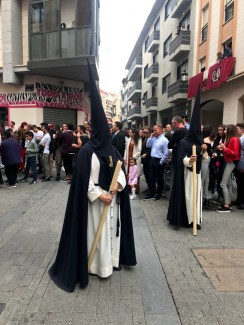
To start, I just finished up spring break, which as usual here, falls during Semana Santa/ Holy Week aka Easter. I personally love Easter, it’s my favorite holiday so I was excited to see it here, despite being a bit homesick during this time. In Spain, Easter is a week-long celebration with processions /parades every evening in the big cities. The floats/alter things are carried by at least 20 men and have some sort of statue of either Jesus or the Virgin Mary on it. They are very beautiful, and I will post a picture below. With the parades there is also music, and people in traditional costumes, that look a lot like the KKK. That startled me at first, but they are not affiliated with a cult or anything. It’s just a traditional costume to symbolize religious oppression or something (not sure). It was still a little bit off putting to see even children dressed up as it.  I went to two of the parades, but to me and my uncultured American brain, they all appeared the same to me. My host family tried to explain the difference between each of the floats and each of the processions, but since I’m not Catholic, I really didn’t understand it all. I was able to appreciate the cultural aspect but the different meanings kind-of went over my head.

That is something I found interesting during my stay here so far. As I knew from before, Spain, and many European countries are very religious. Most holidays are based on the Roman Catholic faith and their culture is very much centered around it. Being American, where there is a big separation of church and state, and we call public Christmas trees “holiday trees”, seeing religious objects and public celebrations was surprising and took getting used to. This isn’t a bad thing at all but is just very different from what we’re use to in the States.


IMG_7952(Nazarenos, that’s what they are called!)

Towards the end of Semana Santa, I went with my host family back to Fuenteheridos to visit the whole extended family at the grandparent’s villa. We were supposed to see another procession here, but unfortunately it was rainy all weekend and for safety reasons, they can’t do the parades in the rain. Oh well. It was still a nice visit (kind of boring but relaxing). This is probably going to be my last visit here while I am in Spain because I only have a little over a month left (6 ish weeks).

At school, I am no longer teaching regular classes and just doing speaking exam preparation with my kiddos, since they all have their Cambridge level exams in May. This has made things a bit easier on my part, planning wise since all I must do to prep is printing out tests, but I do miss doing full lessons with them (which are honestly more fun). Those tests are spread out during the whole months of May, and then I only work a couple of days in June (and we are back on the half day schedule then).

My Spanish classes are going well. The class has dwindled down to just three of us, which is fine by me, because we get more speaking practice. I really like the people in my class too, and we sometimes hang out outside of class. I’ll be sad when the term ends in June and I wish that I had started the classes earlier!


Going back in time a bit…


I went to Granada and Sierra Nevada with my host family to go skiing during my birthday weekend. Granada is about 4 hours away from Huelva and is the southernmost ski resort in Europe. It was so nice to see snow, which I had been really missing this winter (even though it is spring now!). The first night we stayed in this ski lodge right near the ski resort and spent most of the day at the mountain. I was the only one who went skiing though, the rest of them went tubing. The skiing was okay, it seemed like everyone and their brother was there that weekend, so I was only able to get a few runs in since I spent most of the morning in line for the lift. It was still nice though and I wish I had had more time to practice. I also accidently stole some strangers skis and tried to return them to a different shop but that’s another embarrassing story (long story short I can’t ever show my face at that ski rental shop). Overall, it was super cool to ski at a big mountain and now I can say I have gone skiing in Europe.

Anyway…

The next day we went to La Alhambra in Granada, which was honestly my favorite part. It’s this super old historical castle fort thing that was built hundreds of years ago. It took us around 4 hours to go all the way through and it was so beautiful ( pictures below). It was built with strong Islamic influences with mosaics, beautiful architecture and gardens. I honestly think Granada is one of my favorite cities I have visited here. It is still a fairly large city, but is a lot less commercialized compared to other cities in Spain. This trip was a bit of a struggle health wise though because I had a sinus infection and bronchitis so I was coughing at every historical exhibit. No big deal.


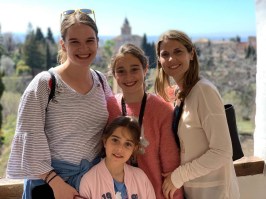
6384649b-c36d-4323-ab95-28a644dfff8e Me, my host mom, Marta and my host sisters, Elena and Cristina on a balcony in La Alhambra.

 

IMG_7686The view from the top of the watch tower in La Alhambra.
So yeah. I only have a little over a month left. While part of me really can’t wait to go home and see my family (and be able to hear English) , I know the minute I leave I’m going to want to come back. Right now I am in the process of finishing up my final report for my online class (12 page report what’s up), and applying for jobs for when I get home. Most places I have applied for have been really understanding of the fact I am away and can only do phone interviews (keep your fingers crossed).

Well, that’s all for now. Stay tuned for more, friends.

Adios!

My progress with Spanish

“Lo siento. Yo estoy aprendiendo español”. That is something I feel like I say a lot. When telling people about my acceptance and placement in the teaching program, one of the first questions most people asked me was “How is your Spanish?”
Yo estoy aprendiendo espanol. I am learning Spanish. Attempting to at least.

I wish I could say that from a young age I have always had a passion for learning languages. I wish I could say that I am bilingual, trilingual and speak and read with ease. Alas, that is not the case for me. Like almost every kid, I had to pick a foreign language to study while in school and since I loved taking the road less traveled, I picked French. And I studied it for 5 years. Am I fluent in French? No. Did I retain any of this language? Growing up, I was surrounded by bilingualism because of my father’s job and I wanted so badly to be good at another language, but that just never happened. My sister picked up the language bug and was able to teach herself Japanese. My dad speaks German fluently and other languages proficiently.
And then there is me. It’s not that I didn’t like learning languages, it is just something that has never came easy to me. While I can say I am okay at reading French after studying it for so long, my speaking and listening comprehension skills are very poor.
So why did I think that learning Spanish would be any different?
For the program I am in, knowing Spanish wasn’t a requirement, as it is for some international teaching programs. They asked me about my knowledge of Spanish during my interview and I was very honest, I had never studied Spanish (besides for a trimester in the 7th grade, but that doesn’t count). Obviously, that didn’t affect me getting the job, because, here I am. When I received my placement and everything became official, back in May, I began to study Spanish. I wasn’t able to take a class but I had work books, dictionaries and apps to help. Before I left for my summer job and then when I returned, I studied almost every day for about an hour or two (ask my mom if you don’t believe me). While I probably would’ve progressed better if I had been able to take a class, I am so glad that I took advantage of that time and studied because it gave me some sort of base line for when I got here.
Let me say, studying the language from a book and actually speaking it in the moment are very different things (Well, duh, Jordan, what did you expect??) The first time I tried to speak Spanish by myself when I was in Barcelona, the first day I had arrived. All I wanted was to order lunch at a café. But when it was my turn, I felt as though I forgot all my Spanish instantly. I was also very jetlagged so that probably didn’t help. Thankfully, English is widely spoken in large cities such as Barcelona, so it wasn’t an issue. But when I arrived in Huelva with my host family, I realized how little I knew. I am really lucky that my immediate host family speaks English very well. My host parents both are at the B2 level (high intermediate) and the girls are both quite good at English for their age. But when we are with the extended family, it becomes a bit more challenging because none of them really speak much English. Right from the beginning though they have all been very patient with me whenever I would try to speak in Spanish but trying to keep up with the conversation for example at the dinner table is very difficult and exhausting at some point. I mean, I am not going to ask them to always speak slowly or to translate what they are saying all the time, and I try to follow the best I can, but often I can only pick up every 3rd word, and by the time I translate it in my head, they are on a new topic. This was more so the case in the beginning, but now it is getting easier. While I don’t understand all of what they are saying, I can often understand the general meaning of what is being said. It is often the case that I can understand more than I can say.
At school, I am not allowed to speak in Spanish in front of the students, though that doesn’t stop them from speaking to me in Spanish. I think they have caught on by now that I can often understand what they are saying. A lot of times, the younger students ask me to say something in Spanish, thinking that they are being funny. But the only students that have heard me speak in Spanish are the students that I tutor outside of school because their parents often don’t speak English. Most of the teachers I communicate with regularly all speak English very well (Bilingual school and all that), so communicating with my coworkers isn’t usually difficult. And if I have to speak with a teacher who happens to not know English well, there is almost always another teacher or student nearby who can help.
The first term I was here, finding a Spanish class wasn’t a top priority for me. I had briefly looked online for somewhere that offered classes that I could get to with my schedule, but no luck. So I was studying with books and by speaking with my host family. While that has been helpful, as you can imagine, it can be difficult to learn a language on your own without formal instruction. So while my Spanish improved greatly the first semester I was here, it wasn’t exactly where I wanted it to be. But again, finding a class wasn’t a huge priority since I was getting use to teaching, tutoring and being here. Now for the second term, for poops and giggles, I looked up classes again that are offered near me. One of the language schools I had looked into recently changed their times for Spanish classes, and if luck would have it, they had some at a time I could go! (Monday mornings). The class I am in is a mix of A1-A2 level and only has about 6 people in it. Most of us are English teachers of some sort, though I am the only conversation teacher (and the only American). To get placed in that class, I had to take a placement test and speaking test, and after giving speaking exams all the time at school to students, it felt very strange to be on the opposite end of one! I now understand why many of my students get nervous and dislike doing practice tests. So far, I am really enjoying the class. It is interesting and I feel like I am learning a lot, especially because it is a small group. It is more conversation focused and has a lot of room to ask questions, which is how I like it. It is also nice to be able to speak with other Spanish learners at a similar level as me (with the supervision of our teacher). I mean, nothing beats speaking to a native to learn a language, but its nice to talk to someone at the same level (and struggle together). I also enjoy the class because it is nice to have sometime in my schedule that I enjoy and that is regular. It is forcing me to be a bit more social (which is something I have trouble with sometimes) and it is nice to do something that is unrelated to my job or my tutoring sessions.
So to answer the question that people ask me about my Spanish level, like I said, I am learning. For someone who has struggled with language learning in the past, I feel like I have made a lot of improvement, going from literally knowing no Spanish to being almost ready to take an A1 level exam (Passing the beginner level of the language). Some days, I feel as though I know nothing, and communicating is hard, and some days, it is easier. I know and can understand more than I realize and if people are patient with me, we can have something that sort of resembles a conversation. I have a lot to work on and a long ways to go, but so far, I am happy with the progress I have made so far with the language.
Hasta Luego!

E(asy)SL Games and More

Hey y’all. Second term is well underway and probably like many teachers, I am starting to feel a drag. The holidays are over and there is just sort of a stale feeling in the classroom. The next holiday is a long way away, exams and evaluations seem to be happening left and right and to most, the weekend can’t come soon enough.

Am I complaining? No. But lets be real, people. Who likes the month of February while in school? No one. So to spice things up a bit, I thought I would talk a bit about some fun ESL games I have used in my classes and talk about how I attempt to jazz up an otherwise boring topic. The way my classes typically work is that I take out students in small (ish) groups for anywhere from 10-20 minutes to reinforce a topic being taught by the head teacher. While sometimes that time has to be used for speaking test preparation (hey, Cambridge exams) I try as often as possible to do some kind of game style activity to break up the class time while still teaching a topic. Some topics, I’ll admit are more difficult to make a game out of (I’m looking at you, passive voice) but I try. So without further ado (adieu?) here are a few simple games that have worked well in my classes.


  1. Taboo!

Yes. Taboo. A staple for game night and a favorite of mine. I usually use this for grades 6 and up and has been proven to be a great way to reinforce vocabulary for literally anything. The way I do this is super easy, I make a PowerPoint presentation with the vocabulary words. One student is in the hot seat facing away from the lap top while the rest of the students can see the word. They have to describe the word to the student but they can’t say any part of the word (so if the word is “Swim suit” they can’t say swim or swimming), they can’t act it out and they can’t say it in Spanish. This could be made more difficult for the older students by also giving a list of key words that they can’t use. I have used this game for so many different vocabulary lists like clothing, nature, arts and entertainment, even a Christmas themed one. An oldie but a goodie.


  1. Parcheesi

I don’t know if this is a Spain thing, but elementary aged students here love parcheesi style board games. And the thing about parcheesi is that it is super easy. Online there are so many templates to make your own board game, you can literally make a board game about anything. Shout out to Pinterest for literally having everything. Also, it is very easy to find already made board games about so many different topics. One website I use a lot is www.teach-this.com . It has pretty much every topic you could think of from verb tenses, conditionals, clauses, passive voice, etc. They also have printable flashcards and worksheets. I use this site a lot for game ideas and a quick board game when needed. I try not to use it too much but in a pinch it is great. One of my favorite topics to use a board game style game is for the different verb tenses. I recently did one with future tense and the phrases “I will” and “Going to” where they had to answer a question using the future tense. Very simple, portable and sometimes can lead to fun conversations with the students.


  1. Relay races

In my classroom, I am lucky to have a very large black board that takes up an entire wall. So of course, I use it. One game I have done with the secondary students is what I call “Irregular verb races”. A topic a lot of my students have trouble with are irregular verbs and all their forms (infinitive, past simple, past participle, future, etc.). For this simple game, all you need is a list of the verbs (for the instructor), plenty of chalk and for an added flare, a hand buzzer, bell or some kind of noise maker if you so choose. I divide the class into two teams who each have their own side of the chalk board. I say the infinite form of an irregular verb (ex. “be”). They then have to write the past simple and the past participle form of the verb on the board correctly before the other team. This can be done in a few different ways. You could have the whole team working together to come up with the correct words. When they are done, they either sit down very fast or use their noise maker. This is mainly for me to be able to clearly see who finished first (often it’s a very close tie). Another variation is to have only one person per team at the board. When they are done writing, they have to run back to their team who are at a different part of the classroom. This is good to really evaluate each student’s abilities rather than having the teams fall to the stronger students. Another variation would be to have several infinitive forms already on the boards and in a true relay race fashion, have the students run up and each fill in the blanks for the past simple and participle, and then return to their team and so on. Relay races can be used for other topics too, such as spelling, superlatives and other verb forms.


  1. Advertisements/infomercials

I am not very original for coming up with catchy game titles but whatever. I’ll leave that to the creative people. This game is geared towards older students (B2-C2 level) and takes up the whole class time. I did this with my C1 testing group that I teach by myself for 50 minutes 3x a week. For this activity I brought in a big box of random things from my classroom including a “magic wand” (a drum stick), a packet of slime, a box of crayons, a tube of hand lotion and a small stuffed Santa from Christmas. I put the students in small groups of 2-3 and each group had to take 1-2 objects from the box. Each group now had about 20 minutes to come up with a 30-50 second advertisement for their object(s). For the commercial, they had to come up with a use for the product (real or made up), a plot/situation/problem/solution, a price, any deals or specials with the product. They must be as creative as possible. And in English, of course. Then they had to present their original commercial to the class. I was a bit nervous doing this with them. I had done similar activities in acting classes I have taught but this group is made up of primarily 11th-12th graders. Sometimes they want to do activities, sometimes no. But it was well received from them and they got really into and were creative. It was very entertaining to see their “commercials”.


  1. Past Tense Charades

This is literally how it sounds. In a small container I have written a bunch of different verbs and activities such as “running”, “dancing”, “cooking”, etc. The student has to take one of the pieces of paper and has to act out the verb or phrase. The other students have to guess what they are doing by making two sentences, the first in present simple and then in past simple. For example, “Miss Jordan is playing basketball” and then, “Miss Jordan played basketball, or “Miss Jordan was playing basketball”.  I have done this with 3rd and 4th grade and they seemed to like it. Kids at that age really like anything that involves moving around and it is a simple way for them to hear the differences between the tenses. It can also be made more challenging by using other verb tenses.


I figured I should talk about some teaching stuff while I was here. Since I mainly teach upper elementary-secondary school, most of these activities are meant for those age groups. I only really see lower primary one day a week, and often their teachers have specific activities that they want me to do with them. So yeah. I hope you enjoyed my incomplete list of very simple ESL games. I have figured out very early on that sometimes simple is better and that way you are able to focus more on what you are teaching rather than the rules and regulations of the games itself. Use what you got. Less is more.

Peace.

Feliz Ano Nuevo y El Día de los Reyes (Day of the Kings)

Hola! Woah, two blog posts in one week? What is happening? Tomorrow I begin my second term as an English teacher here, after a nice long break. If you read my last post (or follow me on social media) I was super lucky to be able to spontaneously go home for Christmas. After a few road bumps in the journey, I was able to surprise my family and stay at home for a little over a week. Although it was a short visit, I was really happy I was able to see them, especially for the holiday. I am so glad I didn’t blow the secret and surprised them. (very surprised I didn’t because I am the worst liar.) It was a bit bitter sweet saying goodbye to them again, but I kept reminding myself how unhappy I would be if for some reason I wasn’t able to return to Spain. These next five months will go by very quickly.

Getting that sentimental stuff out of the way.

When I returned to Spain (after what felt like the longest and most exhausting flight), it was New Years Eve! Even though I was extremely jet lagged, I was determined to participate in a Spanish New years. Back home, I rarely ever do anything on New Year’s Eve (I usually just sleep) but this day if a big deal in Spain. The whole extended family on my host dad’s side went to the grandparent’s house (Abuelo Julio and Abuela Toni!) for a fancy dinner and to count down to midnight. A popular food to eat during the Christmas season is prawns, which are pretty much just very large shrimp. I personally don’t like most fish so I passed on that. But there was plenty to eat such as different types of meat, cheeses and soups. (Jamon all day every day). In America, it is very popular to watch the Ball drop in Times Square on TV. Here, we did gather around the TV for the count down. But instead of a disco ball being anticlimactically lowered down for the countdown, but instead, for the last 12 seconds of the old year, we would eat a grape per second to count down. It felt very silly to do (and a potential choking hazard) but it was a lot of fun. People do that all over the country, even the people on TV hosting the count down. Right after the stroke of midnight, all you could hear were the sounds of illegal fireworks all over the city. What a night. I then slept until almost noon after this, because you know. Jetlag. Very glad I was able to make it for my first Spanish New years! Feliz Año Nuevo!!


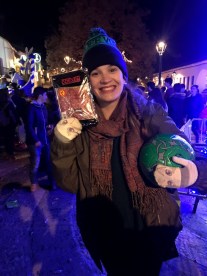
In Spain, while Christmas is a big holiday, the Christmas season officially ends on January 6th, on Epiphany. Here, it is called, El Día de los Reyes (Day of the Kings). This day is when the Three Kings came to see the baby Jesus and bring gifts for him. In Spain, this is less of a religious holiday and is more a gift giving one. The three kings/wise men are essentially their Santa Claus. The night before, on January 5th, most cities and communities have some sort of parade where the different wise men come in on floats and throw candy at people. My host family and I spent this holiday in Fuenteheridos (see my first blog) at the grandparent’s villa with the extended family. Since this town is so small, the parade just went around the town square about ten times. In bigger cities, the people on the floats just throw candies to the spectators, but here, they threw candy, toys, snacks (ham, chestnuts, ect) and other things. My host sisters and their cousins were so excited for this and had been hyping this up for weeks. But I had to see it for myself. In the freezing cold (it was like 40 degrees), we gathered around the town center, armed with trash bags to catch the treats. I thought it was going to be just the kids catching things, but the adults were just as into it as they were. When the floats arrived, there was only about six altogether, three of which had a different wise man on it, with his entourage. Other floats had things like a nativity scene, the characters from the movie Coco and a mermaid (of all things). At first, they were warming up the crowd by just throwing cheap candy and bags of chips but after a few rounds, they started throwing the good stuff. Soccer balls, stuffed animals, toys. People were pushing each other to get them. I caught a soccer ball to the face, a pair of scissors (that were wrapped) and a bunch of other stuff, most of which I quickly put in my host sister’s bags. Rumor had it that they were going to throw a few toy jamons (ham) that could be redeemed for a full size real ham at the market. The coveted prize. I, alas, did not get one. An old lady pushed me. But I did catch a packet of salami. So it wasn’t a total loss. After, we had some Roscón de reyes, which is a traditional cake. It is circularly, like a Bundt cake, with a layer of whip cream or custard and is decorated with candied fruit. Inside, there are two things. If your piece of cake has a small toy in it, you are crowned “the king” and get to wear a paper crown that came with the cake. If you get a nut in your piece, you have to “pay” the “king”. I didn’t get either, but its okay.


IMG_6772.jpg Me and my salami.


That night, the kids went to bed early, I went to my hotel (full house) and they eagerly awaited to see what the kings brought them in the morning. I arrived the next morning a little late because I was in a hotel, but I was greeted by the excitement of my host family’s kids, who already opened their presents. I was able to give my host family their gifts and was surprised to see that they had got me some gifts as well. I was very touched by that since I wasn’t expecting anything.

Overall, this Christmas break was very good. I got to see my family, celebrate new years Spanish style, see the Three Kings and catch some salami at a parade. I am rested and ready for the next semester!


Adios!


Home for the Holidays…

Happy New Year, friends! I apologize that I have not written in a while. As things were getting closer to the holidays, everything just seemed to get a lot busier. Also nothing exciting enough to write about happened. So here I am. New Years.

But Jordan, what about Christmas in Spain? How was it? What did you do? Well, plans changed. Very last minute. The Wednesday before Christmas, while I was at school during my break, I had spontaneously decided to check out flight prices to potentially fly home for Christmas. I had been looking at flights since October because I had this fantasy in my mind that I was going to surprise my family for Christmas in a very dramatic way. But every time I checked, the flights were either too expensive, not at the right times or involved 20 hour lay overs. And I wasn’t about to pay 1000 Euros to spend 24 hours stuck in some random airport in Malta. But why not? I’ll check one more time. Boy oh boy it was my lucky day. I found a flight for under 500 Euros and with reasonable lay overs. (Seville-Dublin-Providence).  I booked it within 10 minutes and was leaving in less than 48 hours. My students that happened to be in my classroom at the moment during the break were wondering why I was stupidly grinning at my computer. I am never this spontaneous. I was quite impressed with myself. After booking, I decided to only tell one friend about my plans so it could be a real surprise.

Fast forward to Friday morning. I took a taxi at 6 am to the bus station in Huelva because my host parents couldn’t drive me that early because of work. I had bought what I thought was a bus ticket online. When I boarded what I thought was the right bus to Seville, I had realized that I had purchased a train ticket instead. Luckily the bus driver allowed me to buy a ticket on the bus. I had been really lucky that the bus and the train happened to be leaving at the same time because if not I would’ve been screwed.

Once I got to the bus station in Seville, I hoped onto the ever convenient shuttle service to the airport. No hitches there. I thought I was in the clear. I was checked in for my flight to Dublin (my layover), had some snacks, bought a neck pillow, I was good. At the moment I was a little nervous about catching my lay over because it was only a two hour layover in an airport I didn’t know. I also was not checked in for my Dublin to Providence flight because the airline I was flying didn’t allow you to check in online. No problem. It would be fine, I told myself as I snacked on dinosaur shaped biscuits.

DING DONG I WAS WRONG.

Because of an increased volume of air traffic (of course), the plane couldn’t land right away in Dublin. So we had to circle the airport for about an hour. Okay, don’t panic. You’re in a different country, have no idea where to go and you might miss your flight. Don’t panic.

Once the plane finally landed, I ran to where I thought was a check in counter, but because I am American, I had to clear customs first. And because everyone and their second cousin is traveling on the Friday before Christmas, the line took about 45 minutes. After proving to them that I did not indeed have any fruit or meat in my luggage, I sprinted at 100 meter pace to the check in counter for my airline that of course was in a different terminal. I got to the counter, sweaty and out of breath. The ticket lady reminded me of that secretary woman from Monsters inc. Anyway, I get there only to find out I had missed the check in time and was unable to check in and board the plane.

What the heck.

If anyone remembers, I do not handle stress well. Especially transportation related stress. Cue tears. Cue hysterics. I tried arguing with the woman. Begging. Please let me on this flight. I am alone. I am sweaty. I don’t have a tooth brush and I need to get home. Its Christmas, Lady!

Nope. My tears did not work. She not so kindly suggested that I try another airline, since they did not have any more flights to Providence or Boston that day. I think that she did not want me to fly with them since I was completely hysterical at this point.

I sob my way to the other terminal and find the airline she was talking about (who shall remain nameless). I get in the line, silently crying, trying to figure out what to do. I need to get home, I paid for a return ticket, so I am not just going to give up and go back to Seville. I didn’t know what to do, I have never missed a plane before. I have never been stranded in a foreign country before (even if they did speak English). At this point I thought I was going be stuck in Ireland forever.

I finally get to the counter and the tears are just gushing right now. I explain my predicament to the kind airline man, who tells me that they have a flight available for tomorrow. To Boston. And it would cost me another 600 Euros.

No. I am not paying that much for a one way when technically my original airline was suppose to help me. The airline man, who seems to be my only ally in this whole country suggests that I go to back to my original airline and demand a new ticket for the next flight. I was skeptical.

Back to where I started. I change terminals for the 5th time today and make my way back to the original airline, where the ticket lady has disappeared but there is an angry mob of stressed travelers. Who all were suppose to be on the flight to Providence but missed the check in because of a delay.

My people. My amigos. My travelers in solidarity. Our new band of brothers marched to the ticket help desk (in another terminal of course) and demanded assistance. But of course we were greeted with the same response (“you are suppose to be at the airport at least 2 hours early to check in for an international flight”). BUT WE COULDN’T BECAUSE OF DELAYS WITH OUR CONNECTORS. A mob is forming. People are getting upset. I am searching on my travel app because I used a third party booking site (shout out to Kiwi.com). And then.  A revelation. On the app with my flight plan I see a little box that says “The Kiwi.com guarantee”. Maybe they have a number that can help me.

Doing what I should’ve done two hours ago, I called it. After being on hold for a bit I finally reached a person. I explained my situation (no more tears) and the lady on the other line apologized profusely. The first time all day someone said sorry and acknowledged that I was upset. She then booked me a new flight for the next day, and a free hotel room in a hotel near the airport. Tears of joy. This day from hell was almost over. I had one less day with my family but it was okay. I was getting home, I didn’t have to pay extra and I didn’t have to spend the night in an airport. I was going to get home. The next day I made sure to get to the airport five hours early so I would not miss the check in time. I ended up calling my sister to come get me from the airport, because at this point, I felt like I had to tell someone in my family about my exhausting journey. I finally made it home a day late, but it didn’t matter. I had ten new gray hairs but I was home for the holidays and I couldn’t be happier.


A reflection:

Looking back at this stressful journey, I probably could’ve handled it a lot better. Yes, I had every right to be upset that I missed my flight and it was a stressful situation. But instead of hysterically running through Dublin airport like a sweaty banshee, I should’ve called my travel site right away. I wasted a lot of time running back and forth between different help desks when my problem could’ve been solved earlier by one phone call. I would like to say that after living in a different country for several months would mean that I was fully well adjusted and calm and is able to handle all stress well, but alas, that is not always the case. This, like every experience I have had these past few months have been a learning experience. And at the moment, sobbing in the land of the leprechauns felt like the only way I could handle it. Learning experience.

So, Feliz navidad. Feliz Ano. (Merry Christmas, Happy New Years). I hope you enjoyed this holiday tale.

New years resolutions? Don’t cry in airports. 


A day in the life

Hola, amigos y amigas! I can’t believe I have been here for almost three months and I am about a third of the way finished with the school year. It has gone by so quickly and it is already almost time for the holidays. I thought I would share with y’all a typical day at school and what my classes are like/ what I do all day. During the months of October-May, I work four days a week at school, Tuesday- Friday. It has been very nice to have 3 day weekends, lemme tell you. Each day, I have anywhere between 4-6 classes that meet for an hour each, depending on the day. Some days there are more/less, for example, if I have to substitute for another teacher or a class has an exam. So, my schedule is different every day. The day I am going to talk about is a typical Tuesday (aka, my Monday). This is usually my busiest day.


Every morning I usually get up and get ready for work around 7:30 ish. During this time, I also am responsible for making sure my host sisters get ready and out of the door at the right time. That has been a bit of a struggle some mornings, and a lot of times we leave a few minutes later than anticipated but we’re working on it. I typically get to school a few minutes before nine, which gives me a few minutes to get out any material I may need for my classes (though I usually try to do this the day before). On Tuesday’s, my first class is 4th of primary (4th grade). This week, we worked on using adverbs of frequency and different question words (who, what, when, etc.) For most of my classes, especially with primary students, I take them out in small groups of 3-8, depending on the class size. For the activity, we played a parcheesi style board game about adverbs of frequency and asking questions (“how often do you…?”). There is this one website that I have found very helpful for finding different grammar exercises, especially games. I will post the link at the end.

After 4th grade, I mosey on to 2nd of primary (2nd grade). These little nugs are one of my more challenging classes, due to their age and low English level. I try to take them out in even smaller groups (no more than four) to reduce distractions. Today, we practiced a Cambridge style exam with prepositions of location (on, at, in, above, etc.). I took them out in pairs, and it went pretty well. I really need to remember to take this class out in small groups.

Every morning from 10:50-11:40 the whole school has their study/recess period. I am very jealous of the older students especially for this; my school never had a scheduled break time when I was in middle/high school. I usually grab a cup of tea and a snack from the teacher’s dining room and then do some work in my classroom for my classes or I lesson prep. During the break periods, the 11th and 12th graders sometimes hang out in my room to study or have a snack. They are good for the most part, we have learned to co-habitate. They clean up after themselves, I pretend not to understand their conversations in Spanish. Balance.

After break, I head on over to 5th grade, which is my largest class. Thirty-two ten year old’s can be quite a handful. For this class, I took them out in pairs to practice for the speaking portion of their KET exam, which is the A2 level in the Cambridge exams. This speaking exam focuses on forming proper question sentences and searching for information in a flyer/ advertisement. This is the second/third round of testing that I have done with this group and almost all of them have improved greatly from the first time. Some of them still have to work on switching the words around for questions, but overall, they are doing well. What a bunch. Their English is good enough that they can hold a basic conversation, but they are still young enough to want to do fun things in class.

My next class is 1st of Primary (1st grade). This is my smallest class, with only 10 students. They are also the youngest students I teach. They are currently studying food, food group and healthy habits. As a review game, we played a simple activity of identifying different name and types of food using plastic play food pieces. They were able to name different foods and identify things, such as what you eat for breakfast and which foods are plant/animal based. Sometimes simple is better for students this young, as long as you make it some sort of game.

Between 1:30-3:00 is the lunch/ extracurricular hour. Every day except Friday, I am able to use this time as another break/prep time. The lunch is usually pretty good (a lot better than it is in American schools). I could go home during this time if I wished, but I usually stay in school because it is easier.

After lunch, I switch from being in the primary part of the school to the secondary. My first class after lunch is 1st of ESO (7th grade). This is one of my favorite classes because they are still young enough that they want to do fun activities, but their English is good enough that we can have nice conversations. Also, this class just tends to be very nice and well behaved. Today we worked on using the past simple/continuous and present perfect verb tenses through story telling. Very similar to the classic “two truths and a lie” game. This age loves these kind of activities and once they get talking, it’s hard to get them to stop and move on.

My last class of the day is a 2nd of ESO (8th grade) class. This class is one of my more challenging groups, mainly because of the age and the class size. They also have a stricter English course load, so we often practice the speaking portion of their exams, which is what we did today. I take them out in pairs and do practice tests with them. Sometimes we do a game of sorts, but we must do a lot of practice these next few weeks since they have their mock exams at the end of November.

After school, most days I tutor students and other kids in the community in English. The youngest child I tutor is three and the oldest is thirteen. On Tuesdays, I usually tutor a 6th of primary student for an hour after school. This is something I do outside of the school and the Meddeas program. I enjoy it because it gives me additional teaching experience (and a way to make some extra money).

So far, I am really enjoying teaching. The first few weeks or so were overwhelming a bit, and there are still some days that I am not fully sure what I am doing, but overall, I think its going well (no one’s complained yet so that’s good). I am really starting to get to know the students (and their names) and they are beginning to be more comfortable with me. While this post wasn’t super exciting (I don’t arrive to school on a pet flamingo, play football every day or bleed sangria and paella), I am proud of myself for how far I have come in these past 3 ish months and how much I have grown already. I get so excited when I see my students progress with their English, and this has been a rewarding experience so far.


Observations of my new home

Hey y’all. Here is an incomplete list of things I have noticed in Spain (or at least where I live). None of these are bad things, they are just things I have observed in my two months here that I found either interesting or different from where I am from. Enjoy!


1.       People are very physical here. Unless it is a professional environment or something, if you are introduced to someone by another person, you are expected to do the two-sided kiss thing. And again, when someone leaves. This threw me off a little when I met my host family. I had been under the impression that that was only done with people you have previously met before and knew, but nope, it is done among strangers and acquaintances. I am getting use to it now, but at first it was strange.

2.       That being said, you would think that in a country where they do the kissing thing that people on the street and in shops would be friendly too but alas, not really. Not necessarily unfriendly but it reminds me a lot of being in a big city. When walking on the street, you don’t make eye contact with others, you don’t talk to others and mind your own business. This I noticed when I was lost in Huelva. Being a socially anxious person, I wanted someone to approach me (and my obvious sobs) but no one did. Again, not a bad thing. You just mind your own business.

3.       People wear shoes in the house here. It is considered strange to not wear anything on your feet while in the house. I don’t know about other people, but I am a barefoot all day kind of person. Usually when I go to someone’s house (that I know) I have been strangely conditioned to always take off my shoes. Don’t know why, I have always done that (so does my family).  I was surprised here that even in the hot summer people wear slippers or shoes in the house. My host family noticed, and my host mom got me a cute pair of slippers. I wear them sometimes, but I honestly forget to a lot.

4.       No one owns driers. In every house I have been in, people have washing machines but no clothes driers. This is obviously more environmentally friendly and economical. My family back home is sort of similar since we do try to hang up our clothes outside when it is nice out but during the winter that is not an option obviously. Here I guess since it doesn’t snow or rain much you can hang up things outside all year round.

5.       Public toilets. They rarely have toilet paper, or soap. They have the dispensers for both and yet 3 times out of 10 they are empty (or torn off the wall). Carry purell and tissues, my friends.

6.       The scheduling of stores is different here. They open later (like 9-11 am) and close a lot later (10-11pm). Stores are also sometimes closed in the middle of the day for lunch and they are usually never open on Sundays (even big super markets and department stores).

7.       Every travel guide online said this but some reason I didn’t really notice until I got here. The meal times are very different. At school I usually eat lunch at 1:30 pm which is kind of normal but at home on the weekends we sometimes don’t eat lunch until 3-4 pm. Dinner is also late (usually between 9-11 pm). That took some getting used to (I sometimes would eat dinner at 5pm back home).

In school:

8.       The school I am at is a bilingual school, but obviously we are closer to England than we are the US. So they teach them British English. This threw me off slightly, especially with different spellings of words and vocabulary (like when I proctor a test). I have had to change some of the words I use (like sneakers to trainers, cookies to biscuits, elevators to lifts ect) so the kids would understand them. Not a bad thing, I feel quite posh when I use the word plaster instead of band aid .

9.       The classes are different here. This might be because I am in a small private school but the amount of classes they offer are really small. Unlike in my high school in the US, students cant pick what kind of courses they take. There is only one class of 20-30 students for each grade and you are with the same group for every class. There are no different levels for math or language (like AP or CP or remedial) and you can’t choose elective classes (except for one course that meets a few times a week, but most students choose to do exam prep).

10.   There aren’t any clubs or sports in this school. I don’t know how it is at other Spanish schools, but in the US in almost every school they offer after school sports and clubs. That is a huge part of someone’s school experience back home (Cross country and Track and Field all the way). Some students do play sports, but they are separate from the school and are usually private lessons. Where I am at, tennis and horse back riding are very popular.

11.   Students here have way more breaks during the day than we did in America. At my school, regardless of grade, they have a study and recess period during the morning for about an hour as well as a full hour and a half for lunch. They do eat in 45-minute shifts (half the school for one and the other for the other) but the rest of the time is either for their elective class (study or exam prep) or another recess. In high school in the US, the school I went to didn’t offer a study period or break, and our lunch was only 24 minutes long. I prefer this system for obvious reasons.

12.   As everyone knows, very unfortunately gun violence is becoming a common issue in schools in the US. So we have become accustomed to things like lock down drills and procedures. Unfortunately it is the norm for us. Here, that doesn’t exist. As far as I know, they don’t have specific lock down procedures in the event of an intruder or a shooter. The school doesn’t even have a PA system to alert students of such things. We have never even had a fire drill in the two months I have been here. After living in America for my whole life and going to school there and doing these things, it was almost surprising and a very sad realization that a lot of other places don’t have these types of issues. I am grateful to be in a place that doesn’t typically deal with these issues, but it is just a sad realization about what students in the US have to worry about every day.


Food: (the way to my heart is through my stomach)

13.   Besides things like the classic paella (which is delicious by the way) there are a few foods that are surprisingly popular here that I was not expecting. Yogurt and pudding are super popular, and most grocery stores have a whole aisle dedicated to them. But the yogurt is more fruit flavored rather than the US’s tendency of making “dessert flavored” yogurt. But yeah. Very popular. The fridge at my host families house has a whole shelf in the fridge dedicated to yogurt and pudding. Me gusta (I like).

14.   Biscuits are also popular. I am not talking about biscuits like what you would eat at KFC or with gravy. These biscuits are like cookies and are all pretty much the same flavor (but with hundreds of different brands). Kind of like British tea biscuits. Kids eat them for breakfast which I found kind of strange at first but hey. Life is short. Eat a cookie (biscuit) for breakfast. My favorite brand are these ones called Tosta Ricos. I recommend. They have cartoon pictures on them and sometimes are shaped like dinosaurs.

15.   In the area I live in, they eat a lot of meat. Every meal I have eaten, (lunch and dinner) there is always some kind of meat dish as the main entre. Maybe for some this is normal, but I personally come from a family that only really eats meat a few times a week. When I was in college I only ate meat maybe once every two or three weeks. So I have been getting a lot of protein. I have also tried fish and have eaten more fish these past two months than I have in my entire life. I kid you not.


That’s all I got for now. Obviously, this isn’t everything that is different from America and these are purely my experiences so far here. Thanks for reading. Stay tuned for more (wait for me to do something exciting first). Adios.


Lost in Huelva

What a day.

What made this day a “day”, you may ask? Well, my friend. Sit back, relax, and enjoy this tale of pure chaos, tears and language barriers.

On this fine Tuesday in Spain, I had to do a chore that I have been putting off since I arrived here a month ago. In order to legally work here I need something called my TIE card, which is basically my Spanish ID card. If I didn’t get it, my visa would expire. So this morning bright and early, my host dad, Antonio drove me to the government building in Huelva, which is the closest city, and capital of the province that I live in (also called, Huelva). Huelva is a pretty small city, and is only a 10 minute drive from the town that I live in (Aljaraque). He dropped me off, I got my ticket number and then proceeded to wait in the line for about two hours. Totally fine. I was kind of nervous, since he didn’t stay with me, so I didn’t have anyone to help translate for me, but it ended up being okay. After the really long wait, when it was my turn, the lady who saw me to do the paper work didn’t speak English but was really nice and tolerated my broken Spanish. We got the job done, the appointment only took 15 minutes and now I am officially work-legal in Spain. Great. Fabulous. Check that off my to-do list.

But wait. It’s gets fun.

One thing that has been a slight problematic issue since my arrival in Spain has been my cellphone situation. Right? Me, thinking I was brilliant for doing so, bought a cheap nokia phone to use for calls and texting while in Spain and reserved my iPhone for use only with WiFi. In most everyday situations here, that has been okay. It has been slightly annoying having to carry two phones, but whatever. I have managed fine.

UNTIL NOW.

You see, my iPhone doesn’t have a Spanish data plan, so while I am walking on the streets, unless I happen to come across some sparse free public unlocked WiFi, this phone is useless. And my other phone only has the capability for calling and texting Spanish phone numbers. So without a data plan, I am unable to use any apps, including MAPS.

Knowing this, before he dropped me off, my host dad kindly informed me that there was a tourist center down the street from the police building I was at, where I could obtain a map, which would later help me find the bus station I needed in order to leave Huelva and get home. New ID card in hand, several hours later, I boldly set off in what I think is the right direction to find the tourist center to get a map to get home.

Well ding dong I was wrong. I had boldly set off in the wrong direction and ended up walking for about a mile before realizing my grave mistake. Mildly concerned, but keeping my cool, I pop in the nearest supermarket to ask for help.

MISTAKE NUMBER TWO.

Since getting accepted into the teaching program back in May, I have slowly but surely been studying Spanish. I have books, I have notes, I have it all. But this was my first time really by myself without anyone to help translate for me. No matter. I am a strong, confident learner of the languages. I can do it. So I confidently set off into the store and asked the clerk, “Where is the bus stop (en espanol).” I was greeted with a confused look. I asked again, the same way but slightly louder and slower. The poor woman looked even more confused and was just shaking her head. At this point, her co-workers are staring at us, so I ask one of the onlookers the same question. He has no idea what I am saying. I am speaking in Spanish, but my accent is so bad that they don’t understand.

Can you feel the frustration? I can.

I embarrassingly apologize for my apparent cultural and linguistic insensitivity and leave the store. Well. What do I do now? I then not so boldly retrace my steps and restart my journey in the opposite direction, mentally rehearsing how to ask where the bus stop is. Hopefully I can find someone who speaks English.

I hound down this one non-serial killer looking lady and ask her the same question that has been plaguing me for the last 30 minutes. “Where is the bus station?” She looks just as confused as the store people. So I just repeat the word “BUS”, several times before she points vaguely in a direction, before dismissing me and my desperate request. I can feel the frustration and emotion building. I don’t know where I am. I don’t know if this is the right direction. And no one seems able to help me. Tears are starting to form behind my two dollar sunglasses. I am getting profoundly sweaty as I speed walk in the direction the lady pointed, as if walking faster will help.

I find myself in one of the many central plazas of Huelva. I look around. People are so calmly enjoying their noon time café con leche and toast at the many outdoor cafes. They appear blind to my now free flowing tears and perspiration. I try to pull myself together and not be overcome with the thought that I may or may not be stuck in Huelva forever. Over yonder, I see a Burger King. One of the only two American restaurants in the whole Provence. In my chest I feel a sense of glee, a sign I recognize. Maybe they have someone who speaks English in there and can help me. So I square my shoulders and head into the Whopper Lair. I meekly ask the Burger king lady, where is the bus station. Why did I expect different results? She shook her head. So once again, I repeated myself several times. Her face lit up. My heart leapt. Did someone just understand me? Was this trial over? The Burger Queen lead me from the store and pointed to a bus stop. That was about 200 meters away. Not exactly what I was looking for, but hey, it was a start in the right direction. I humbly thanked the Burger Queen and with a bit more joy in my step, set off for the bus stop, coin purse in hand. But which bus was it? I looked at the schedule at the stop and couldn’t find my town or any of the surrounding towns on it. Okay. Don’t panic (again). Maybe its like Rhode Island where you can get on any of them and it’ll take you to the main terminal.

When the bus pulled in, I asked the bus driver if the bus was going to Bellavista, which is the stop I needed. And guess what he did? He shook is head. Shocking. So I repeated myself, slower, louder, spanishier. No luck. He looked very bothered by me, a simple American girl, just trying to find her way home. He gruffly pointed me off the bus. Openly crying now, 1,75 euros in hand, I leave the bus and repeat this process on two more buses.

What do I do now? I have no idea where I am, no map, and no translating abilities. I am standing in the middle of Huelva, literally sobbing almost hysterically at this point, with no idea what to do. So I keep walking, trying to pull myself together. This feels like a reoccurring nightmare. I feel invisible. I am so frustrated about my inability to communicate. I look around, trying to find somewhere, anywhere I can go where someone, anyone might help me. I spot a pastry/ gelato shop. Behind the counter are several youngish women, who may be my best shot since younger people tend to know more English around here. Trying to hold myself together, I walk in, ready to repeat this upsetting process all over again.

The lady wave me in and asks me for my order. Cue the tears. I am incoherent. I sob as I try to ask for help, saying I am lost. The woman rushes out from behind the counter and gives me a hug which makes me cry more for some reason. I am just so done with today. I ramble in Spanglish about my situation and this Godsend of a woman does what I have wanted to do all day. She pulls out her phone to Google Translate and prompts me to type in what I want to say. FINALLY. Through my tears I quickly type, “I am lost and need help. I don’t know where I am, I don’t speak Spanish and I need to find the bus station.” Her face lights up. We have a connection. Arm around my shoulder, she leads me out of the shop and down several streets to THE BUS STATION. I cry tears of joy now. After almost two hours of being lost, I have finally reached my destination. I profusely thanked this kind bakery woman (whose name I believe was Ana), we parted ways and fifteen minutes later, I was seated on the bus to the correct destination.

What a ride.

What a day.

To some, this might not seem that big of a deal. But for me this was a test. Like I said, up until this day I had never really been by myself in Spain. I have always had either a friend, coworker or someone in my host family to help me translate when things get rough. This was the first time I had to navigate a new city and a new language by myself. Please believe me when I say, I have been learning Spanish, because I have. But this was the first time I really had to speak it outside of the controlled environment like my host families house or my school, where there were always English speakers who could kindly correct me when I mispronounce things. For me, this was an eye opener of how much I took being able to communicate for granted. I had never been in a situation before where I was the one who couldn’t communicate. And not being able to effectively ask, “where is the bus station?” was very difficult. Not being able to tell people that I was lost and needed help was stressful. I felt so alone in those few hours. This was the first time I really realized exactly how far away from home I was. I feel as though I have aged 10 years and I am a changed woman.

Don’t be like me kids. Travel smart. Print out a map ahead of time. Get a data free translating app. Learn better Spanish pronunciation and stay hydrated. I hope you enjoyed this tale of tears and woe. Peace.